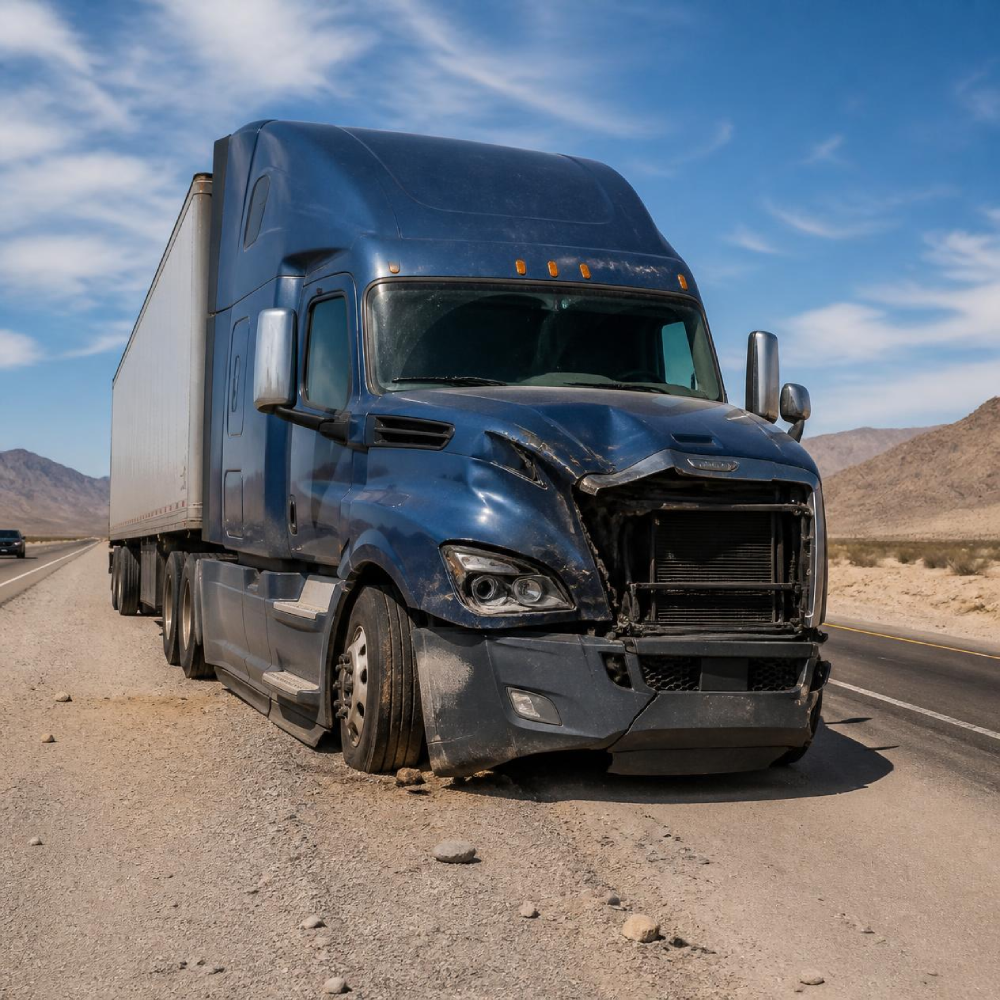
A jackknife accident occurs when a commercial truck’s trailer swings out at an angle to the cab, forming a shape resembling a folding knife — and in doing so, sweeps across multiple lanes of traffic with devastating effect. These crashes are among the most dangerous types of commercial vehicle accidents, capable of destroying every vehicle in their path and causing mass casualties on a busy freeway. Truck Accident Law Firm Nevada represents victims of jackknife truck accidents throughout the Las Vegas metropolitan area, pursuing full accountability from the drivers, carriers, and other parties responsible for these catastrophic events. Call 702-702-6903 today for a free consultation with an experienced jackknife accident lawyer. Nevada’s I-15, which carries a massive volume of commercial freight through the Las Vegas Valley and across the Mojave Desert, is a documented site of jackknife incidents — particularly on the grade descents approaching the valley from the south near Jean and on the steep interchange ramps of the Spaghetti Bowl.
Jackknife Accidents: How They Happen and Why They Are So Dangerous
The Mechanics of a Jackknife
A jackknife occurs when the drive wheels of a tractor-trailer lock up or lose traction during braking, causing the tractor to decelerate while the trailer — which has its own momentum — continues forward and swings outward. Once the trailer begins to rotate relative to the cab, it moves beyond the point where the driver can recover directional control, and the vehicle’s geometry collapses into the characteristic folded shape. The entire process can unfold in a matter of seconds, leaving other motorists with no time to react or escape the path of the swinging trailer.
The destructive potential of a jackknifing trailer is enormous. A standard 53-foot trailer swinging outward can sweep across three or more lanes of freeway traffic, striking multiple vehicles simultaneously. Vehicles caught in the trailer’s path may be pushed into barriers, rolled over, or crushed beneath the trailer’s frame. The secondary crash sequence — as vehicles that have been struck collide with others, or as traffic approaching from behind runs into the stopped jackknifed truck — can multiply the casualty count far beyond the initial impact.
Brake System Failures as a Leading Cause
Inadequate or failed braking is the most common mechanical cause of jackknife accidents. Commercial trucks use air brake systems that require correct air pressure, properly adjusted slack adjusters, and well-maintained brake drums and pads across all axles — both on the tractor and the trailer. When braking force is applied unevenly across axles — because of a defect, a maintenance failure, or improper adjustment — some wheels lock while others continue to roll, creating the differential deceleration that initiates the jackknife sequence.
Federal regulations under 49 CFR Part 393 specify detailed requirements for commercial vehicle brake performance, including stopping distance standards and brake force distribution requirements. A truck that cannot meet these standards is legally unfit for operation on public roads. When a carrier deploys such a vehicle and a jackknife results, the carrier’s liability is direct and substantial. Brake maintenance records and pre-trip inspection logs are key evidence in these cases, and our attorneys act immediately to preserve them.
Driver Error and Improper Braking Technique
Even a mechanically sound truck can jackknife if the driver applies brakes incorrectly. Hard, sudden braking on a slick surface — or even a dry surface at high speed — can induce wheel lockup. Experienced commercial drivers are trained to use controlled braking techniques that avoid lockup, to use engine braking to slow the vehicle before applying service brakes on descents, and to recognize the early signs of trailer sway that precede a full jackknife. When a driver lacks this training, ignores it under time pressure, or panics and overbrakes in an emergency, the resulting jackknife may be directly attributable to their conduct.
Carrier responsibility for driver training is a critical liability consideration in jackknife cases. A carrier that fails to provide adequate training on braking technique, particularly for operations in mountainous or high-speed interstate environments, has created a foreseeable risk that falls squarely within the scope of negligent training liability. Personnel records, training logs, and simulator records are all potentially relevant evidence when driver training is at issue.
Investigating a Jackknife Accident and Establishing Liability
Speed and Grade as Contributing Factors
Excessive speed is a frequent contributing factor in jackknife accidents, particularly on descending grades where truck drivers must manage both vehicle speed and brake heat. The approach to Las Vegas from the south on I-15 involves long descents from the Nevada high desert into the valley floor, and drivers who fail to gear down appropriately or who exceed safe speeds for the grade risk both brake fade and the loss of trailer control that leads to jackknifing. Nevada’s 511 Nevada traveler information system provides current data on road conditions and incidents on major state highways, and historical incident data from NDOT can establish patterns of jackknife risk at specific locations.
Cargo distribution also affects jackknife risk on grades. A trailer loaded with cargo concentrated at the rear has a higher tendency to swing outward under braking than one with evenly distributed weight. When improper cargo loading by a third-party loader or the carrier’s own dock workers contributed to the jackknife, those parties may share liability for the resulting crash. Investigating cargo loading records and interviewing loading personnel is an important part of the factual development in jackknife cases where cargo distribution may have been a factor.
Preserving the Physical and Electronic Evidence
The physical evidence at a jackknife crash scene is rich with information about how the accident unfolded. Tire marks — both from locked wheels and from the scrubbing of the trailer’s tires as it swung — reveal the trajectory of the jackknife sequence. Gouge marks in the pavement indicate where vehicle components contacted the road surface. The final resting positions of the tractor, trailer, and involved vehicles, combined with damage patterns on each, allow accident reconstruction specialists to calculate the forces involved and determine the sequence of events with precision.
Electronic evidence from the truck’s EDR and ELD systems is equally important. Speed at the moment of brake application, brake pedal pressure, and the precise timing of wheel lockup relative to the onset of trailer swing can all be extracted from these systems by qualified forensic engineers. Our attorneys secure this evidence immediately through preservation demands and, where necessary, court orders requiring the carrier to maintain the vehicle in its post-accident condition pending inspection by our experts.
Hyperlocal Jackknife Risk on Las Vegas Freeways
The geography of the Las Vegas Valley creates specific jackknife risk zones that differ from the hazards facing motorists on flat, straight highways. The I-15 interchange complex at the Spaghetti Bowl — where elevated ramps curve sharply as they connect I-15, US-95, and SR-93 — requires truck drivers to slow significantly from freeway speeds while navigating tight curves. The combination of speed reduction, lateral forces on the trailer, and the elevated and curved road surface creates conditions where improper braking can initiate a trailer swing that quickly becomes an unrecoverable jackknife.
The approach corridors to the Las Vegas Convention Center along Paradise Road and the industrial access routes in North Las Vegas also see commercial truck traffic operating in stop-and-go conditions where abrupt braking is frequent. While jackknife incidents in urban stop-and-go environments typically occur at lower speeds than freeway jackknifes, they are no less dangerous to pedestrians, cyclists, and vehicle occupants in the immediate vicinity, and the urban density means that secondary collisions with parked vehicles, storefronts, and infrastructure are common.
Multi-Vehicle Crash Coordination in Jackknife Cases
Because a jackknifing trailer can simultaneously strike multiple vehicles, jackknife accidents frequently produce multiple injured plaintiffs. Managing the legal claims of numerous injured parties arising from a single incident requires careful coordination to ensure that each victim’s interests are fully protected and that the available insurance coverage is not exhausted before every injured party’s claim is resolved. When multiple plaintiffs hold claims against the same defendant and the total of those claims may exceed available policy limits, the strategic and ethical complexity of the representation increases substantially.
Our attorneys are experienced in managing multi-plaintiff trucking cases, coordinating with other counsel where appropriate, and developing strategies that maximize recovery for all injured parties. We also assess whether additional coverage may be available through umbrella policies, broker liability, or claims against parties other than the primary truck operator — including cargo owners, loading companies, or vehicle manufacturers whose product defects contributed to the crash.
Speak with a Jackknife Accident Attorney in Las Vegas Today
The violence and chaos of a jackknife accident leaves victims with serious injuries, mounting medical bills, and no clear path forward. Truck Accident Law Firm Nevada provides the legal expertise and aggressive representation that jackknife accident victims need to pursue full accountability and maximum compensation. Our attorneys serve injured clients throughout Las Vegas, Henderson, North Las Vegas, and the surrounding communities of Clark County. Call 702-702-6903 today for a free consultation with a jackknife accident attorney who will fight for every dollar your injuries entitle you to recover.