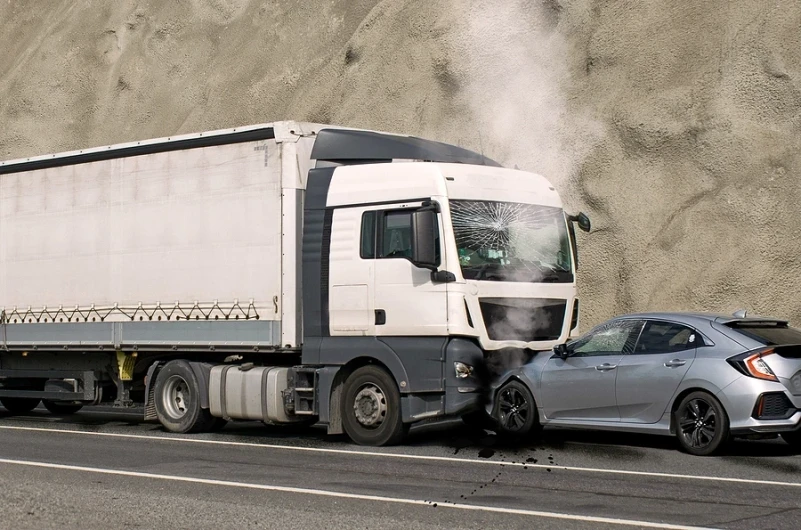
Underride accidents are among the deadliest types of collisions involving commercial trucks, and they occur with tragic frequency on Nevada’s highways and city streets. An underride crash happens when a smaller vehicle slides beneath the frame of a semi-truck’s trailer, causing the trailer to override the passenger compartment and inflict catastrophic or fatal injuries on the vehicle’s occupants. Truck Accident Law Firm Nevada represents underride crash victims and their families throughout the Las Vegas area, pursuing aggressive legal action against the carriers, manufacturers, and other parties responsible for these preventable tragedies. Call 702-702-6903 today for a free consultation with an underride accident lawyer. Clark County’s network of high-speed approach corridors — including the segments of I-15 south of the city and US-95 through the northwest valley — see a disproportionate share of severe underride incidents involving interstate freight carriers.
Understanding Underride Accidents: Types, Causes, and Consequences
Rear Underride vs. Side Underride
There are two primary categories of underride accidents. A rear underride occurs when a vehicle traveling behind a truck fails to stop before reaching the trailer and slides beneath the trailer’s rear end. This type of crash most commonly occurs on highways when a truck brakes suddenly, when a truck is stopped or moving slowly in a lane of traffic without adequate warning, or when a truck pulls into the path of a vehicle traveling at speed. Rear underrides are particularly deadly because the trailer overrides the passenger vehicle’s hood and windshield, bypassing the front crumple zones that are specifically designed to absorb impact energy.
Side underride accidents occur when a vehicle strikes the side of a trailer and slides beneath it laterally. These crashes most frequently happen at intersections, where a truck making a wide turn swings its trailer into the path of a vehicle with the right of way, or where a vehicle runs a signal and strikes the side of a trailer crossing the intersection. Side underride guards — protective barriers along the sides of trailers — are not currently required by federal law in the United States, though advocacy groups including the Insurance Institute for Highway Safety have long called for their mandate, citing compelling evidence that they save lives.
Federal Requirements for Underride Guards
The National Highway Traffic Safety Administration (NHTSA) requires rear underride guards — also called rear impact guards or ICC bumpers — on most commercial trailers. These guards are intended to prevent a passenger vehicle from sliding beneath the trailer by providing a barrier at bumper height. However, the federal standards governing these guards have been criticized as inadequate: the strength requirements have not been substantially updated in decades, and research by the IIHS has demonstrated that many compliant guards collapse under real-world crash conditions, failing to prevent underride.
When a federally compliant rear underride guard fails to prevent underride in a crash, the manufacturer of the guard may be liable under products liability theory for a design that was inadequate to its stated purpose. The trailer manufacturer and the carrier who maintains the trailer may also face liability if the guard was damaged, improperly maintained, or modified in a way that compromised its effectiveness. Our attorneys work with safety engineering experts who specialize in underride guard evaluation to assess the role of guard failure in every underride case we handle.
Lighting, Conspicuity, and Driver Visibility
Many rear underride accidents occur in conditions of reduced visibility — at night, in fog, in rain, or at dusk — when a driver approaching a stopped or slow-moving truck may not perceive the trailer until it is too late to stop. Federal regulations require commercial trailers to be equipped with reflective tape along their sides and rear, as well as operational rear lights, to make them visible to approaching drivers. When a trailer’s reflective tape is worn, obscured, or missing, or when rear lights are non-functional, the carrier has created a foreseeable hazard that directly contributes to underride risk.
Parking and stopping practices also bear on underride risk. A truck that parks partially in a lane of traffic, stops in a shoulder area that is inadequately lit, or makes an unannounced stop on a highway without activating hazard lights presents a hazard that a following driver may not have time to perceive and respond to. When a carrier’s driver fails to follow proper stopping and parking procedures and an underride results, the driver and carrier face direct negligence liability for the consequences.
Pursuing Legal Accountability After an Underride Crash
The Multi-Party Liability Framework
Underride accident cases frequently involve multiple potentially liable parties, each of whom may attempt to shift responsibility to the others. The truck driver may blame road conditions or the actions of the victim’s vehicle. The carrier may argue that the truck was properly equipped and maintained. The trailer manufacturer may contend that its guard met all applicable federal standards — a defense that, while technically accurate, does not necessarily preclude products liability claims based on the guard’s inadequate design relative to real-world crash performance. The guard manufacturer may argue that the carrier failed to maintain the guard properly.
Navigating this web of overlapping and competing liability requires a legal team that can simultaneously pursue parallel theories against multiple defendants, manage discovery across multiple parties, and present a coherent unified narrative to a jury. Our attorneys have the litigation infrastructure and the multi-defendant experience to pursue every responsible party while keeping the focus squarely on what matters most: the full compensation our client deserves.
Hyperlocal Underride Risk Factors in Las Vegas
Several features of the Las Vegas road environment elevate the risk of underride accidents for local motorists. The I-15 corridor south of the city — where freight traffic is heaviest and speeds are sustained at or above 70 mph — creates conditions where a truck stopping for any reason in or near a travel lane presents extreme underride risk. The volume of commercial traffic on this corridor, combined with the relatively limited lighting in the rural segments between Jean and the city limits, makes nighttime underride risk particularly acute.
Within the Las Vegas Valley itself, the intersection-heavy grid of major arterials creates numerous opportunities for side underride incidents. The wide turning radii required by semi-trucks on streets like Tropicana Avenue, Flamingo Road, and Sahara Avenue frequently bring trailer sides into conflict with vehicles in adjacent lanes or in crosswalks. Delivery trucks servicing casino properties and resort hotels on the Strip make frequent turns in areas dense with pedestrian and vehicle traffic, and side underride risk in these environments is a documented concern for safety advocates and transportation engineers.
Injuries in Underride Crashes
The injuries sustained in underride accidents are among the most severe in all of personal injury law. Because the trailer overrides the passenger compartment rather than engaging the vehicle’s frontal crumple zones, the occupant protection systems designed into modern vehicles — airbags, seatbelts, structural reinforcement — are largely bypassed. Decapitation and fatal head injuries are tragically common in severe rear underride crashes. Survivors of underride accidents frequently sustain traumatic brain injuries, severe facial trauma, cervical spine injuries, and crush injuries to the chest and upper extremities.
In cases where occupants survive an underride crash, the injuries sustained often require immediate surgical intervention, extended intensive care, and long-term rehabilitation. The lifetime costs of care for a severe underride crash survivor rival those of any catastrophic injury category. Our attorneys approach underride injury cases with the full complement of medical, vocational, and economic experts needed to document and present the complete scope of these life-altering losses.
Wrongful Death in Underride Accident Cases
Because underride accidents are so frequently fatal, a substantial proportion of the cases our attorneys handle in this category are wrongful death claims brought by surviving family members. Nevada law allows eligible survivors — including spouses, domestic partners, children, and in some cases parents — to pursue compensation for the economic and non-economic losses caused by the death of a loved one in an underride crash. The grief, the financial dependency, and the irreplaceable human loss that underride fatalities cause are all recognized as compensable under Nevada’s wrongful death statute.
Wrongful death underride cases are pursued with the same thoroughness as injury cases — including full investigation of the crash mechanics, analysis of guard performance, and assessment of carrier negligence — with the additional dimension of documenting the specific losses suffered by each surviving family member. Our attorneys handle wrongful death underride cases with the combination of legal rigor and compassionate support that grieving families deserve.
Contact an Underride Accident Attorney in Las Vegas Today
An underride crash is one of the most violent and devastating events that can occur on a public roadway, and the legal fight for accountability and compensation is equally serious. Truck Accident Law Firm Nevada brings the expertise, the resources, and the commitment to pursue every responsible party on behalf of underride crash victims and their families throughout Las Vegas and Clark County. Call 702-702-6903 today for a free consultation with an underride accident attorney who will pursue justice without compromise.