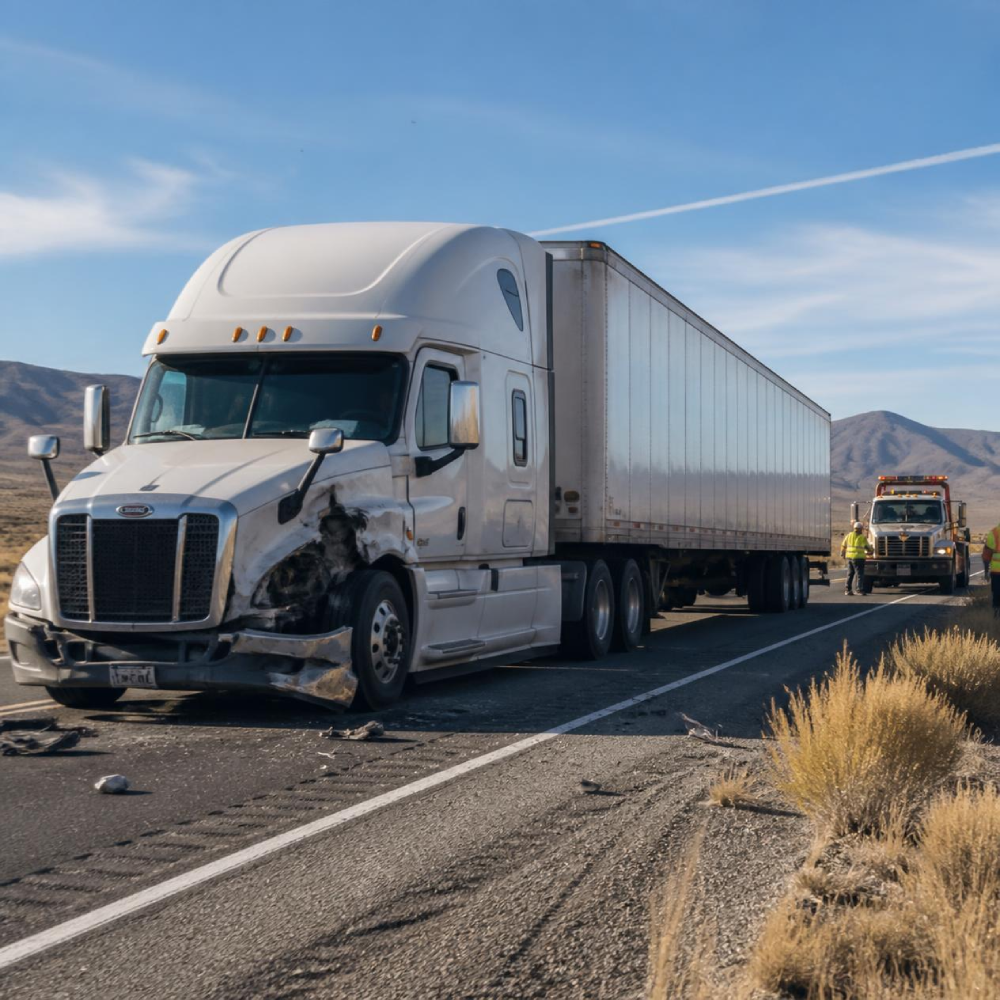
A jackknife accident — in which a commercial truck’s trailer swings outward at an angle to the cab — is one of the most violent and unpredictable types of commercial vehicle crashes on public roads. When a jackknifing trailer sweeps across multiple lanes of traffic, it can destroy every vehicle in its path and cause injuries to dozens of people in a matter of seconds. Truck Accident Law Firm Nevada represents jackknife accident victims throughout the Reno area, pursuing full legal accountability from every party whose negligence contributed to these catastrophic events. Call 702-702-6903 today for a free consultation with a jackknife accident lawyer. The I-80 descent from the Sierra Nevada into the Truckee Meadows is among the most documented jackknife risk zones in Nevada — a long, steep grade where trucks that have lost effective braking or whose drivers have misjudged their approach speed can lose trailer control in a sequence that unfolds faster than any driver in the area can respond.
Jackknife Accidents in Reno: Causes, Mechanics, and Liability
The Physics of a Jackknife on Mountain Grades
A jackknife occurs when the drive wheels of a tractor-trailer lock up or lose traction during braking, causing the tractor to decelerate while the trailer — which has its own substantial momentum — continues forward and begins to rotate around the fifth-wheel coupling. Once the trailer begins to swing outward, the aerodynamic and gravitational forces acting on it overwhelm the driver’s ability to steer the tractor back into alignment. The vehicle geometry collapses into the characteristic folded shape and the driver loses all meaningful control. The entire sequence can unfold in seconds, offering other motorists no time to react or escape.
On the descending grades approaching Reno from the west on I-80, the jackknife risk is compounded by the speed that trucks accumulate during the descent and the reduced braking effectiveness that results from brake heat buildup on long grades. A truck that enters the descent at excessive speed or that has already depleted its brake effectiveness through overreliance on service brakes may not be able to slow itself before reaching the lower grade sections where traffic is denser and stop-and-go conditions can arise suddenly. The combination of high speed, reduced braking, and a laden trailer creates jackknife conditions that are both foreseeable and preventable through proper driver training and vehicle maintenance.
Brake System Failures and Pre-Trip Inspection Duties
Inadequate or failed braking is the most common mechanical cause of jackknife accidents. Commercial truck air brake systems require correct air pressure throughout the system, properly functioning and adjusted slack adjusters, adequate brake lining thickness on all axles, and clean, dry brake chambers free of moisture contamination. When braking force is applied unevenly across axles — whether because of a maintenance failure, an improperly adjusted component, or a defect introduced during manufacturing or repair — the resulting differential deceleration initiates the trailer swing that leads to jackknife.
Federal regulations under 49 CFR Part 393 establish detailed performance requirements for commercial vehicle brake systems, including stopping distance standards and brake force balance specifications. A truck that cannot meet these standards is legally unfit for operation on public roads, and a carrier that deploys such a vehicle — whether knowingly or through inadequate inspection — faces direct liability for any resulting crash. Pre-trip inspection logs and maintenance records are critical evidence in brake-related jackknife cases, and our attorneys act immediately to preserve this documentation through formal legal hold demands.
Driver Training and Speed Management
Experienced commercial drivers are trained to recognize the early warning signs of trailer sway — the precursor to a full jackknife — and to respond with controlled, progressive brake application rather than the panic braking that often initiates a jackknife sequence. They are also trained to use engine braking and transmission downshifting to manage vehicle speed on descending grades without relying solely on service brakes, preserving brake effectiveness for emergency stops. Drivers who lack this training, or who ignore it under time pressure, create foreseeable jackknife risk that their carriers should anticipate and prevent through adequate training programs and ongoing supervision.
Carrier responsibility for driver training in mountain driving techniques is a recurring and critical liability issue in Reno-area jackknife cases, given the prominence of the Sierra Nevada crossing in the truck traffic profile of this region. A carrier that assigns a driver with no mountain driving experience to a heavily loaded trailer on the I-80 Donner Pass descent has made a foreseeable and preventable negligent deployment decision. Personnel records, training logs, and prior assignment history are all potentially relevant evidence in establishing whether adequate mountain driving training was provided and whether the driver’s experience level was appropriate for the specific route assignment.
Cargo Distribution and Its Effect on Jackknife Risk
The distribution of cargo within a trailer significantly affects the vehicle’s stability under braking and its susceptibility to jackknife. A trailer loaded with cargo concentrated at the rear has a higher effective rotational momentum, making it more likely to swing outward when the tractor brakes. Asymmetric loading — more weight on one side than the other — creates lateral instability that can initiate a swing even when braking forces are evenly applied. Federal cargo securement standards require proper weight distribution as well as physical securement of cargo, and failures in load distribution planning are a potential source of liability that extends beyond the truck driver to the loading company, the shipper, and the carrier’s own dock personnel.
When a jackknife investigation reveals that cargo distribution may have contributed to the incident, our attorneys pursue all parties in the cargo chain — the shipper who directed loading, the third-party loading company, and the carrier who accepted the load without adequate verification of weight distribution — to ensure that every responsible party is held to account. Loading records, bill of lading documentation, weight ticket records, and post-crash cargo inspection findings are all relevant to establishing whether improper load distribution was a contributing factor in the jackknife sequence.
Investigating and Litigating Reno Jackknife Cases
Physical and Electronic Evidence
The physical evidence at a jackknife crash scene is rich with information about the sequence of events and the forces involved. Tire scrub marks from the locked drive wheels of the tractor reveal the point at which wheel lockup began and the direction of the trailer’s swing. Gouge and scrape patterns in the road surface indicate where trailer components contacted the pavement during the rotation. The final resting positions of the tractor, trailer, and all involved vehicles, combined with their damage patterns, allow reconstruction specialists to calculate the forces involved and determine the timeline of the jackknife sequence with precision.
Electronic evidence from the truck’s event data recorder and ELD system is equally critical. Pre-crash speed, brake application timing and pressure, engine RPM, and transmission gear position can all be extracted from these systems by qualified forensic engineers. This data, correlated with the physical evidence at the scene, produces a comprehensive reconstruction that is difficult for the defense to challenge without equally rigorous counter-analysis. Our attorneys secure all electronic evidence through immediate preservation demands and, where necessary, court orders requiring the carrier to preserve the truck in its post-crash condition pending independent expert inspection.
The Reno I-80 Descent: A High-Risk Jackknife Zone
The I-80 descent from the Sierra Nevada into Reno is a documented high-risk jackknife zone that has been the site of multiple serious commercial vehicle incidents over the years. The grade on this segment reaches up to seven percent in some sections, requiring drivers to actively manage descent speed over an extended distance using the full complement of speed management techniques available to commercial vehicle operators. The transition from the mountain grade to the flatter valley floor near the Reno city limits creates a point where a truck that has been traveling too fast or whose brakes have been degraded by heat may suddenly be unable to control its speed relative to decelerating traffic entering the city.
The Nevada Department of Transportation and the Nevada Highway Patrol maintain runaway truck ramps and truck inspection stations on the I-80 corridor approaching Reno, reflecting official recognition of the elevated hazard that this corridor presents for commercial vehicles with brake or speed management problems. A truck that bypasses a required inspection station, or that fails an inspection and is placed out of service but somehow continues to operate, presents additional evidence of carrier and driver negligence that our attorneys pursue aggressively in jackknife cases arising from this corridor.
Multi-Vehicle Liability and Insurance Coordination
Because a jackknifing trailer can simultaneously affect multiple vehicles across multiple lanes, jackknife accidents frequently produce multiple injured plaintiffs whose claims must be coordinated against the same defendants and the same insurance policies. When the total of all claims may approach or exceed the available policy limits, strategic coordination becomes critical to ensuring that each injured party receives the maximum recovery possible given the available coverage. Our attorneys are experienced in multi-plaintiff trucking cases and develop strategies that maximize recovery for all injured parties while maintaining the individual attention that each victim’s unique circumstances deserve.
Beyond the primary carrier’s commercial liability policy, our attorneys investigate all available sources of coverage in multi-vehicle jackknife cases. Umbrella policies, cargo owner liability coverage, broker liability insurance, and manufacturer product liability coverage may all be relevant depending on the specific facts of the case. Identifying and pursuing every available insurance layer is an important component of maximizing recovery in jackknife cases where the severity and number of injuries may strain a single policy’s limits.
Contact a Jackknife Accident Attorney in Reno Today
A jackknife accident on Reno’s mountain approach roads or urban freeways can cause injuries of devastating severity and create a legal situation of corresponding complexity. Truck Accident Law Firm Nevada brings the investigative resources, expert network, and litigation experience needed to pursue full accountability on behalf of jackknife accident victims throughout northern Nevada. Call 702-702-6903 today for a free consultation with a jackknife accident attorney who will fight for every dollar of compensation you are entitled to recover.