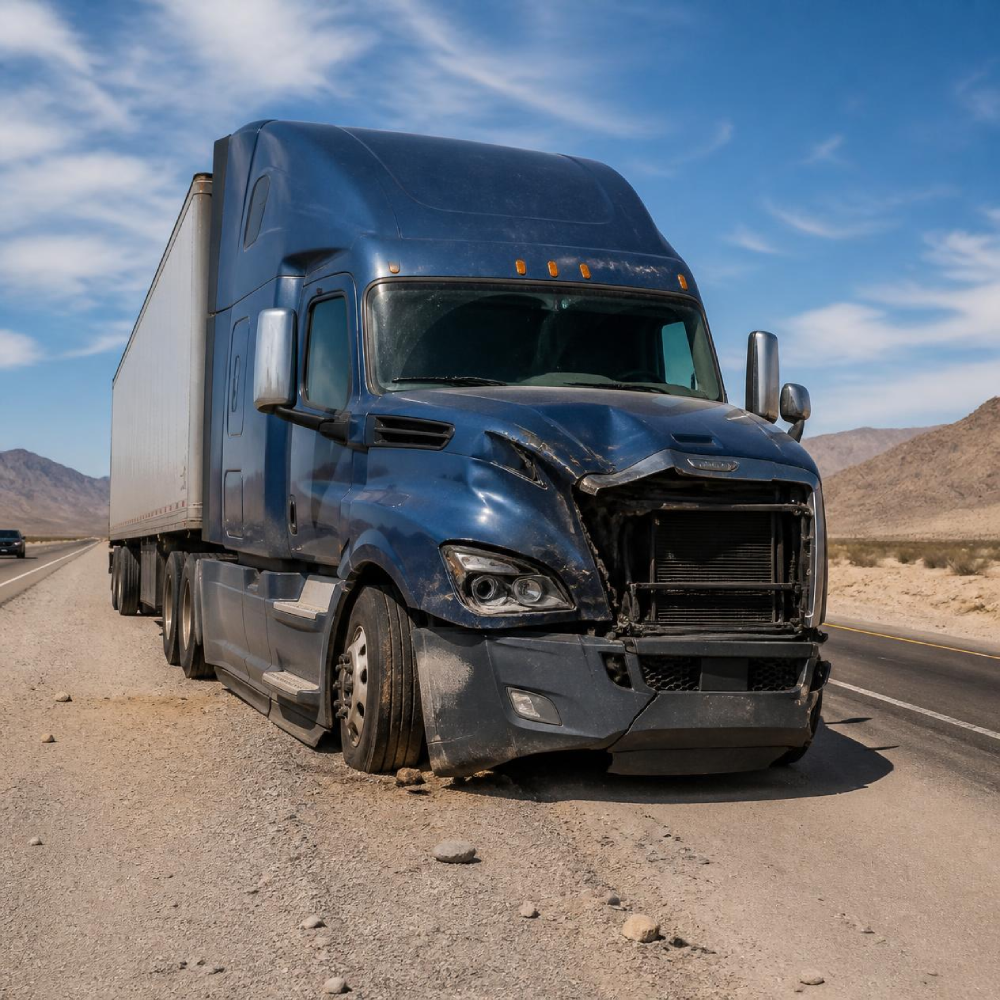
Truck Accident Law Firm Nevada helps families across the state recover after collisions involving fully loaded semi-trucks, the eighteen-wheelers that move goods along Interstate 15 and Interstate 80 every day. These vehicles can weigh up to 80,000 pounds when loaded, and a crash involving one often causes injuries far more severe than a typical roadway collision. A semi-truck lawyer who understands federal weight limits, cargo securement rules, and the mechanics of these massive vehicles can build a stronger case on your behalf. Whether your crash happened near the Las Vegas Beltway or along a rural stretch outside Fernley, our team is ready to investigate what went wrong. We provide a free consultation to every injured Nevadan who contacts our office. Call 702-702-6903 to get started.
How Weight and Cargo Rules Shape Semi-Truck Safety in Nevada
Semi-trucks operating on Nevada highways are subject to federal weight limits that cap gross vehicle weight at 80,000 pounds on the interstate system, with additional restrictions tied to axle spacing and configuration. These limits exist because an overloaded truck behaves differently in nearly every respect: its stopping distance increases substantially, its center of gravity shifts, and its tires and brakes wear at an accelerated rate. When a carrier or shipper allows a trailer to exceed these limits, whether through inaccurate weighing or intentional overloading to save a trip, the resulting truck becomes far harder to control in an emergency.
Cargo securement adds another layer of risk that is often overlooked until something goes wrong. Federal regulations specify how freight must be blocked, braced, and tied down depending on its shape and weight, and Nevada’s mix of long highway stretches and mountain grades makes proper securement especially important. A shipment that shifts during a sudden lane change or an emergency stop can throw the trailer off balance, contributing to a rollover or a loss of control that a properly loaded truck would have avoided. Investigators look closely at load manifests, weigh station records, and bill-of-lading documentation to determine whether the cargo was loaded and secured correctly before the truck ever left its origin point.
Nevada’s weigh stations, positioned along major routes including I-15 near the California border and I-80 in the northern part of the state, are intended to catch overweight vehicles before they cause harm. However, not every truck passes through a weigh station, and some carriers route drivers around these checkpoints specifically to avoid detection. When this kind of evasive routing contributes to a crash, it can become an important piece of evidence showing that the carrier knew its vehicle was operating outside legal limits.
The mechanical demands placed on a semi-truck’s braking system are also far greater than those on a standard passenger vehicle, particularly given Nevada’s elevation changes along routes like the Geiger Grade or the descent into the Truckee Meadows near Reno. Air brake systems require regular inspection and adjustment, and a fleet that defers this maintenance to keep trucks on the road creates a foreseeable risk of brake failure. Maintenance logs, inspection reports, and any prior citations issued by the Nevada Highway Patrol often reveal whether a carrier was cutting corners before the collision occurred.
Driver training specific to handling a fully loaded semi-truck also plays a significant role in preventing crashes. Maneuvering an 80,000-pound vehicle through mountain curves, sudden desert crosswinds, or dense Las Vegas valley traffic requires skills that go beyond a standard commercial license test. When a driver lacks adequate experience or training for the specific conditions of a Nevada route, that gap in preparation can become a central issue in establishing why a crash occurred.
Tire failure represents another mechanical risk specific to semi-trucks operating under heavy loads across Nevada’s hot desert climate. Extended exposure to high pavement temperatures during summer months in the Las Vegas valley can accelerate tire degradation, and an underinflated or aging tire is far more likely to suffer a catastrophic blowout at highway speed. When a tire fails on a loaded semi-truck, the sudden loss of control can send the vehicle into adjacent lanes or off the roadway entirely, and maintenance records showing whether tires were inspected and replaced on schedule often become central to establishing fault.
Insurance coverage for semi-truck operations typically involves substantial policy limits given the scale of harm these vehicles can cause, and Nevada’s minimum financial responsibility requirements for interstate carriers are set well above standard auto insurance minimums. Many carriers also maintain excess or umbrella coverage, and identifying every applicable policy is an important step in ensuring a claim is valued according to the true extent of the harm suffered rather than limited by an initial, incomplete understanding of available coverage.
Building the Evidence That Determines Fault
Establishing exactly what happened in a semi-truck collision requires gathering physical evidence quickly, since much of it can be lost within days if no one intervenes. The truck’s electronic control module often records speed, braking, and throttle data in the moments before impact, offering an objective account that can either confirm or contradict a driver’s version of events. Scene photographs, skid mark measurements, and witness statements gathered soon after the crash help reconstruct the sequence of events before memories fade or physical evidence is cleared from the roadway.
Weigh station records, cargo manifests, and maintenance logs are typically held by the carrier itself, which means a formal preservation request must go out promptly to prevent routine deletion or destruction of these records. Federal regulations require carriers to retain certain documents for specific periods, but those windows can be shorter than families expect, particularly for electronic logging device data tied to hours of service.
Once the evidence is assembled, it is compared against applicable federal and state safety standards to identify where the carrier or driver fell short. This comparison often reveals whether the crash resulted from an isolated driver error or a broader pattern of neglected maintenance, inadequate training, or scheduling pressure that put an unsafe vehicle on the road in the first place.
Nevada’s summer heat places additional stress on a semi-truck’s mechanical systems beyond tires alone, including engine cooling systems and braking components that can overheat during long descents from mountain elevations into valley floors. Carriers operating in Nevada year-round should account for these seasonal demands in their maintenance schedules, and a failure to do so, when it contributes to a crash, becomes an important part of establishing the carrier’s negligence.
A thorough case evaluation also considers the driver’s employment history with the carrier, including any prior safety violations, disciplinary actions, or patterns of complaints from other drivers or motorists. This background information can reveal whether the carrier had reason to know a particular driver posed a heightened risk and failed to act on that knowledge before the crash occurred.
Ultimately, the strength of a semi-truck accident claim rests on how thoroughly each of these threads, mechanical condition, cargo practices, driver background, and roadway conditions, is investigated and documented, since insurers rarely concede fault without a clear and well-supported account of what went wrong.
Contact a Nevada Semi-Truck Accident Attorney
Semi-truck crashes on Nevada’s interstates and rural highways often involve complex evidence tied to weight limits, cargo securement, and mechanical maintenance, and building a strong claim requires moving quickly before that evidence is lost. Truck Accident Law Firm Nevada has represented injured people from the Las Vegas valley to the high desert corridors of I-80, and our team knows how to investigate these cases thoroughly. As your semi-truck accident attorney, we manage every stage of the claims process while you focus on recovering. Consultations with our office are always free, with no pressure to commit until you understand your options. Call 702-702-6903 today to discuss your case with a Nevada legal team that understands how these crashes happen.